

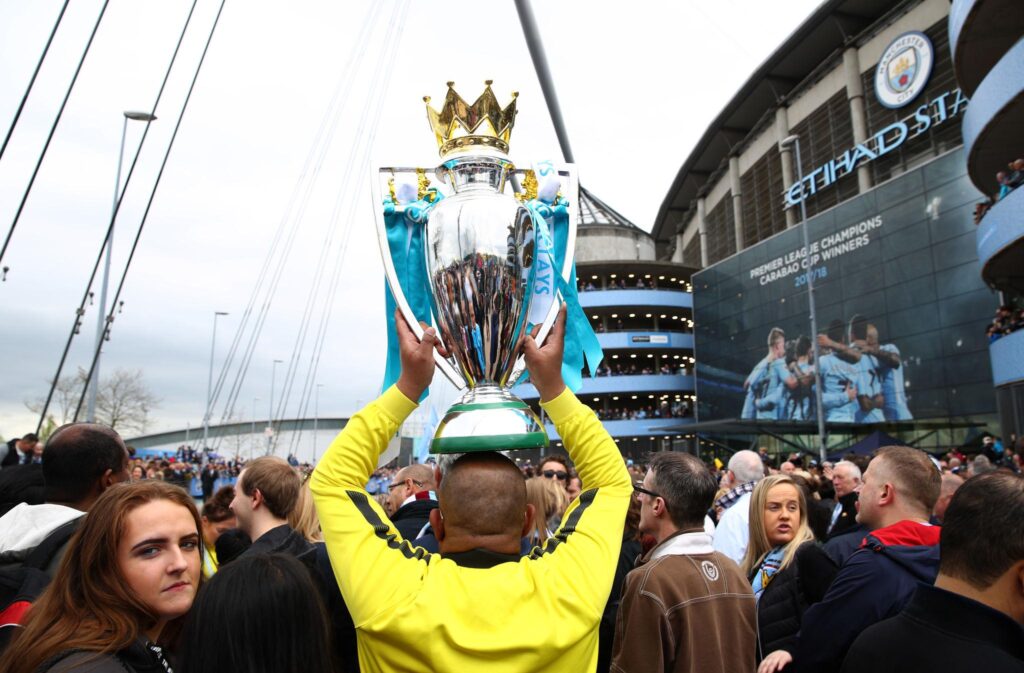

The Premier League is not just one of the most popular football competitions in the world. It is also one of the most powerful and financially successful sports leagues on the planet.
Every weekend, millions of people watch clubs such as Manchester United, Liverpool, Arsenal, Chelsea, Manchester City and Tottenham Hotspur. Television companies pay enormous sums for the right to broadcast those matches, sponsors pay to associate themselves with the competition, fans spend money on tickets and merchandise, and clubs generate additional income through commercial partnerships.
But this raises an interesting question:
How much money does the Premier League actually generate, and how much of that money goes back to the clubs?
The answer involves billions of pounds.
In the 2024/25 season, Premier League clubs collectively generated approximately £6.8 billion in revenue, according to Deloitte’s 2026 Annual Review of Football Finance. That was an increase of about £490 million from £6.3 billion the previous season.
The Premier League also distributes enormous amounts of money to its clubs through broadcasting, commercial revenue and other central payments.
And this money is one of the major reasons Premier League clubs can afford to pay footballers some of the highest salaries in world football.
The Premier League Generated £6.8 Billion in 2024/25
The most recent complete financial data gives us a remarkable picture.
In the 2024/25 season, the combined revenue of Premier League clubs reached approximately:
£6.8 billion
That represents an 8% increase compared with the £6.3 billion generated in 2023/24.
To understand how enormous that number is, £6.8 billion works out to roughly:
£566 million per month
or approximately:
£18.6 million per day
across all 20 clubs, although the actual income does not arrive evenly every day.
And remember: this is club revenue, meaning it includes the money generated by the clubs themselves from broadcasting distributions, commercial activities, matchdays and other football-related income.
Where Does All This Money Come From?
The Premier League’s financial machine is powered primarily by three major revenue streams:
1. Broadcasting
2. Commercial revenue
3. Matchday revenue
There is also additional income from UEFA competitions, player sales and other activities, but these three categories are fundamental to the Premier League’s financial model.
1. Broadcasting Money
Broadcasting is one of the biggest reasons the Premier League is so wealthy.
Television companies and streaming platforms pay enormous amounts for the rights to show Premier League matches.
Why?
Because millions of people want to watch.
The Premier League is followed around the world, and its global audience makes its broadcasting rights extremely valuable.
In 2024/25, Premier League clubs collectively generated approximately:
£3.4 billion from broadcasting
according to Deloitte.
That represents roughly half of the clubs’ total revenue.
The Premier League essentially sells the right to broadcast its football to media companies, and a significant portion of that money eventually makes its way to the clubs.
Why Do Television Companies Pay So Much?
Imagine a company has millions of customers who want to watch Manchester United, Liverpool, Arsenal or Manchester City every weekend.
The broadcaster can make money through:
- Subscriptions
- Advertising
- Sponsorship
- Pay-per-view arrangements
- Streaming subscriptions
- International distribution
Therefore, Premier League broadcasting rights become extremely valuable.
The league’s popularity creates demand.
Demand creates expensive broadcasting contracts.
And those contracts create enormous revenue for the clubs.
2. Commercial Revenue
Commercial income has become increasingly important.
In 2024/25, Premier League clubs generated approximately:
£2.4 billion in commercial revenue
This represented a 13% increase compared with the previous season.
Commercial revenue includes money from things such as:
- Shirt sponsorship
- Kit deals
- Club sponsors
- Merchandise
- Licensing
- Global partnerships
- Advertising
- Stadium events
- Corporate partnerships
The biggest clubs have enormous global brands.
Manchester United, for example, can sell shirts and sponsorship rights to supporters and companies around the world.
Liverpool can do the same.
Manchester City can do the same.
Arsenal can do the same.
This is why a Premier League club is not simply a football team.
It is also a global entertainment and commercial business.
3. Matchday Revenue
The third major source is money generated inside the stadium.
This includes:
- Match tickets
- Hospitality
- Corporate boxes
- Food and drinks
- Matchday merchandise
- Stadium experiences
In 2024/25, Premier League clubs generated more than £1 billion in matchday revenue for the first time, according to Deloitte.
That is remarkable because the Premier League only has 20 clubs.
The league’s average stadium attendance also reached a record 40,459 per match, with stadiums operating at approximately 98.8% capacity during 2024/25.
This demonstrates how important the fans are to the league’s financial success.
So How Does the Premier League Pay Its Clubs?
This is where the system becomes particularly interesting.
The Premier League centrally sells its broadcasting and commercial rights.
The money generated from those rights is then distributed among the clubs according to a formula.
The objective is not simply to give Manchester City and Manchester United the most money.
The Premier League deliberately uses a distribution system intended to maintain competitive balance.
The league itself says that central revenue is distributed equitably to clubs to support competition and reinvestment.
Does Every Club Get the Same Amount?
No.
But Premier League clubs receive substantial central payments.
The amount a club receives depends on factors such as:
- Equal-share payments
- Domestic television appearances
- Final league position
- International broadcasting distributions
- Other central commercial distributions
This means that finishing higher in the table generally results in more money.
A club that finishes first therefore receives more than a club finishing 20th.
However, the difference is not so enormous that the bottom club receives nothing.
This is one of the reasons the Premier League is considered more financially balanced than many other major European leagues.
The Difference Between Revenue and Profit
This is extremely important.
When you hear:
“Premier League clubs generated £6.8 billion.”
That does not mean they made £6.8 billion in profit.
Revenue is the money coming into the businesses.
Clubs then have enormous expenses.
And one of their biggest expenses is:
Players’ wages.
Premier League Clubs Paid £4.4 Billion in Wages
This is perhaps one of the most astonishing figures.
In 2024/25, Premier League clubs’ combined wage costs reached approximately:
£4.4 billion
That was a record level and represented an increase of £381 million from the previous season.
So if you are wondering how Premier League clubs can afford to pay footballers enormous weekly salaries, this is a major part of the answer.
The league generates enormous revenue.
The clubs receive a significant share of that revenue.
And a large portion is spent on players and staff.
How Much Is £4.4 Billion in Player Wages?
Let’s make the number easier to understand.
£4.4 billion per year is approximately:
£366.7 million per month
£84.6 million per week
£12.1 million per day
across all Premier League clubs.
Of course, this is not money paid only to footballers.
The wage bill includes employees and football-related staff, although players make up a major component.
Why Can a Footballer Earn £200,000 a Week?
Let’s say a club pays a star player:
£200,000 per week
Over a full year, that is approximately:
£10.4 million
before considering bonuses and other payments.
It sounds extraordinary.
But from the perspective of a club generating hundreds of millions of pounds in revenue, elite players are among its most valuable assets.
A world-class player can help a club:
- Win trophies
- Qualify for the Champions League
- Sell shirts
- Attract sponsors
- Increase global popularity
- Sell more tickets
- Increase television interest
- Increase commercial revenue
Therefore, clubs view elite players not simply as employees but as major sporting and commercial assets.
Does the Premier League Give Clubs All Its Money?
No.
The Premier League also spends significant amounts supporting football outside the 20 clubs.
This is something many fans don’t realize.
During the 2024/25 season, the Premier League committed more than £550 million to the wider game.
This includes support for areas such as:
- The EFL
- Non-league football
- Academies
- Women’s football
- Girls’ football
- Grassroots football
- Community programmes
- Stadium improvements
So the money generated by the Premier League doesn’t simply stay within the 20 clubs.
The £1.6 Billion Wider-Football Investment
The Premier League reported that between 2022 and 2025, it committed approximately:
£1.6 billion
to wider football and communities.
That demonstrates the scale of the league’s financial influence.
It supports football far beyond the Premier League itself.
How Much Does the Bottom Club Receive?
The exact amount varies by season because broadcasting and other distributions change.
But even the club finishing at the bottom receives a very substantial amount compared with clubs in many other leagues.
This is one reason relegation is so financially significant.
A club can go from receiving Premier League distributions to operating in the Championship, where revenues are dramatically lower.
The financial difference can be enormous.
That is why clubs sometimes spend heavily to avoid relegation.
Why Relegation Is Financially Terrifying
Imagine a club has built its squad around Premier League income.
It has:
- High player wages
- Expensive coaches
- Large stadium expenses
- Significant staff costs
- Transfer commitments
Then it gets relegated.
Broadcasting income can fall dramatically.
The club may still have Premier League-level expenses but Championship-level revenue.
This is one reason parachute payments exist.
Recently relegated clubs receive financial support over subsequent seasons to help them adjust to the loss of Premier League income.
Why Promotion Is Worth So Much
The opposite is also true.
For a Championship club, promotion to the Premier League can transform its financial position.
Deloitte estimates that newly promoted clubs can generate approximately £210 million to £365 million in additional revenue over three seasons, depending on whether they remain in the Premier League.
That explains why Championship clubs sometimes take enormous financial risks trying to win promotion.
The reward is potentially hundreds of millions of pounds.
How Much Does the Premier League Make From Sponsorship?
Commercial revenue across Premier League clubs reached approximately £2.4 billion in 2024/25.
This includes a huge range of commercial arrangements.
Companies pay to have their brands associated with Premier League football.
Examples include:
- Shirt sponsors
- Sleeve sponsors
- Kit manufacturers
- Technology partners
- Banking partners
- Automobile partners
- Airline partnerships
- Sportswear companies
- Beverage companies
- Financial companies
The value of sponsorship has increased dramatically as the league’s global audience has grown.
Why Are Premier League Clubs So Valuable?
A major reason is their ability to generate recurring income.
A club can potentially earn money from:
Broadcasting
Commercial deals
Matchday income
European competitions
Merchandise
Player sales
Stadium events
Other business activities
This creates a powerful financial ecosystem.
The Champions League Adds Another Layer
There is another major source of money that should not be confused with Premier League central payments.
When Premier League clubs qualify for UEFA competitions, particularly the Champions League, they can receive additional European broadcasting and prize money.
In 2024/25, Premier League clubs participating in UEFA competitions collectively received approximately £474 million in UEFA distributions, according to Deloitte.
This money is separate from the Premier League’s domestic central distribution.
Therefore, a club competing in the Champions League can potentially earn substantially more than a Premier League club that doesn’t qualify.
Why Manchester United, Liverpool and Arsenal Can Still Make More Money
Although the Premier League tries to distribute central revenue relatively equitably, clubs have their own independent sources of income.
This is where the biggest clubs can pull away.
Consider a club with:
- 70,000+ stadium capacity
- Millions of global supporters
- Huge merchandise sales
- Worldwide sponsors
- Major social-media following
- Champions League participation
That club can generate hundreds of millions of pounds outside its basic Premier League distribution.
This is why the biggest clubs remain commercially powerful even when the league tries to maintain competitive balance.
The Premier League’s Financial Formula
A simplified way to think about the Premier League’s financial system is:
Premier League earns money
⬇️
Broadcasting + commercial rights generate billions
⬇️
Central revenue is distributed to clubs
⬇️
Clubs add their own ticket, sponsorship and commercial income
⬇️
Clubs pay wages, transfers, staff and operating expenses
⬇️
Remaining money can become profit, be reinvested or fund other activities
This is the financial engine behind the competition.
So How Much Money Does the Premier League Generate?
Using the latest complete 2024/25 financial data:
Premier League clubs’ combined revenue:
£6.8 billion
Broadcasting revenue:
£3.4 billion
Commercial revenue:
£2.4 billion
Matchday revenue:
More than £1 billion
Combined wage costs:
£4.4 billion
These figures demonstrate just how much money flows through English top-flight football.
Where Does the Money Actually Go?
It is important to understand that revenue isn’t simply divided between owners and players.
Money is spent on:
- Player wages
- Coaches
- Academy development
- Stadium maintenance
- Training grounds
- Medical departments
- Security
- Travel
- Administration
- Transfers
- Agents
- Taxes
- Community programmes
- Women’s teams
- Youth teams
- Infrastructure
Football is an extremely expensive business to operate.
Why Players Are Paid So Much
Ultimately, footballers are paid enormous salaries because the football industry generates enormous amounts of money.
A Premier League match can be watched by millions of people.
That audience attracts broadcasters.
Broadcasters attract advertisers.
Advertisers attract sponsors.
Sponsors provide money.
Fans buy tickets.
Fans buy shirts.
Clubs sell commercial partnerships.
All of this creates a financial ecosystem capable of supporting huge player salaries.
The footballer is at the center of the product.
Without talented players, there would be no Premier League product to sell.
The Premier League Is a Financial Giant
The Premier League’s financial strength is one of the main reasons it attracts the world’s best players.
A player can potentially earn more in England than he could in many other leagues.
Clubs can pay enormous transfer fees.
Stadiums are packed.
Television audiences are enormous.
Sponsors want association with the competition.
And the league has one of the strongest global brands in sport.
The Premier League’s own 2024/25 annual report says approximately 1.9 billion people follow the competition worldwide, while 1.45 billion people watched live Premier League football during the season under its reported audience measurement.
That global popularity is ultimately what powers the money.
Final Answer: How Much Does the Premier League Generate and Pay Its Teams?
The clearest way to summarize it is this:
| Financial area | 2024/25 figure |
|---|---|
| Combined Premier League club revenue | £6.8 billion |
| Broadcast revenue | £3.4 billion |
| Commercial revenue | £2.4 billion |
| Matchday revenue | Over £1 billion |
| Combined wage costs | £4.4 billion |
| UEFA distributions to Premier League clubs | £474 million |
| Premier League commitment to wider game in 2024/25 | £550m+ |
The important point is that the £6.8 billion is not money that the Premier League simply collects and then divides equally among the 20 teams. It is the combined revenue generated by the clubs, which includes central Premier League distributions as well as each club’s own commercial and matchday income.
The Premier League centrally markets its broadcasting and commercial rights and distributes the resulting central revenues among clubs using a formula designed to maintain competitive balance.
And the scale is enormous.
£6.8 billion comes into the Premier League clubs.
£4.4 billion goes toward wages.
More than £1 billion comes from matchdays.
About £3.4 billion comes from broadcasting.
And approximately £2.4 billion comes from commercial activities.
This is why Premier League footballers can earn salaries that seem almost unbelievable.
The money isn’t appearing from nowhere.
It comes from billions of fans, broadcasters, sponsors, advertisers, ticket buyers, merchandise customers and commercial partners around the world.
The Premier League has effectively turned football into one of the world’s biggest entertainment businesses.
And as its international audience continues to grow, the amount of money flowing through the competition is likely to become even larger.