

Football is no longer just a sport.
It is a massive global business worth billions of euros every year. Behind every major football club is a complicated financial machine involving television rights, ticket sales, merchandise, player transfers, social media, sponsorships and commercial partnerships.
Among all these sources of income, sponsorship has become one of the most important.
Major companies are willing to spend millions of dollars and euros to associate their brands with the world’s biggest football clubs because football provides something traditional advertising cannot always provide: global attention and emotional connection.
When millions of fans watch a club every week, every shirt, stadium advertisement, interview and social-media post becomes an opportunity for a sponsor to reach potential customers.
And when it comes to combining global popularity, sporting success and commercial power, one club stands above almost everyone else:
Real Madrid.
The Spanish giants have built one of the most powerful commercial operations in world football, attracting major international companies and generating hundreds of millions of euros from commercial activities.
But what makes Real Madrid so attractive to sponsors?
How much money does the club actually make commercially?
And which other clubs are competing with Real Madrid for sponsorship dominance?
Let’s take a closer look.
What Does It Mean to Be the Most Sponsored Football Club?
Before naming the club, there is an important distinction to make.
The phrase “most sponsored football club” can mean different things.
It could mean:
- The club with the largest number of sponsors
- The club with the most valuable sponsorship contracts
- The club with the highest sponsorship revenue
- The club with the highest total commercial revenue
- The club with the most valuable brand
- The club with the largest global commercial reach
These are not necessarily the same thing.
For example, one club might have 30 sponsors, while another has 15 sponsors that collectively pay much more money.
Therefore, when discussing the biggest sponsored club financially, commercial revenue and the value of sponsorship partnerships are much more useful measurements than simply counting the number of sponsors.
And under this measurement, Real Madrid is currently the strongest candidate for the world’s most commercially powerful football club.
Real Madrid: The Commercial Giant
Real Madrid has transformed itself into much more than a football club.
It is a global entertainment and sports brand.
The club’s worldwide popularity gives it enormous commercial value.
In the 2024/25 season, Real Madrid generated approximately:
€1.161 billion
in total revenue.
More impressively, approximately:
€594 million
came from commercial activities.
That commercial figure includes areas such as sponsorships, merchandising and other commercial operations.
This made Real Madrid the world’s highest-revenue football club at the time. (realmadrid.com)
And the club’s commercial growth has continued.
For the 2025/26 season, Real Madrid reported operating revenue of approximately:
€1.221 billion
with marketing revenue also increasing. (realmadrid.com)
Why Do Companies Want to Sponsor Real Madrid?
The answer is simple:
Millions of people pay attention to Real Madrid.
A company doesn’t sponsor a football club simply because it likes football.
It sponsors the club because it wants visibility.
Real Madrid gives companies access to an enormous international audience.
The club has supporters across:
- Europe
- Africa
- Asia
- North America
- South America
- The Middle East
This means a company that partners with Real Madrid can potentially expose its brand to consumers across multiple continents.
That is incredibly valuable.
The Real Madrid Jersey Is Advertising Real Estate
Look at a modern football shirt.
There can be several commercial positions:
Front of shirt
One of the most valuable advertising positions.
Shirt sleeve
Another highly visible sponsorship location.
Training kit
Training shirts can have separate sponsors.
Shorts
Another commercial opportunity.
Stadium
Companies can have their logos displayed around the stadium.
Digital platforms
Sponsors can appear across social media, websites and digital content.
The more people watching, the more valuable these spaces become.
And Real Madrid has one of the biggest audiences in world football.
Emirates and Real Madrid
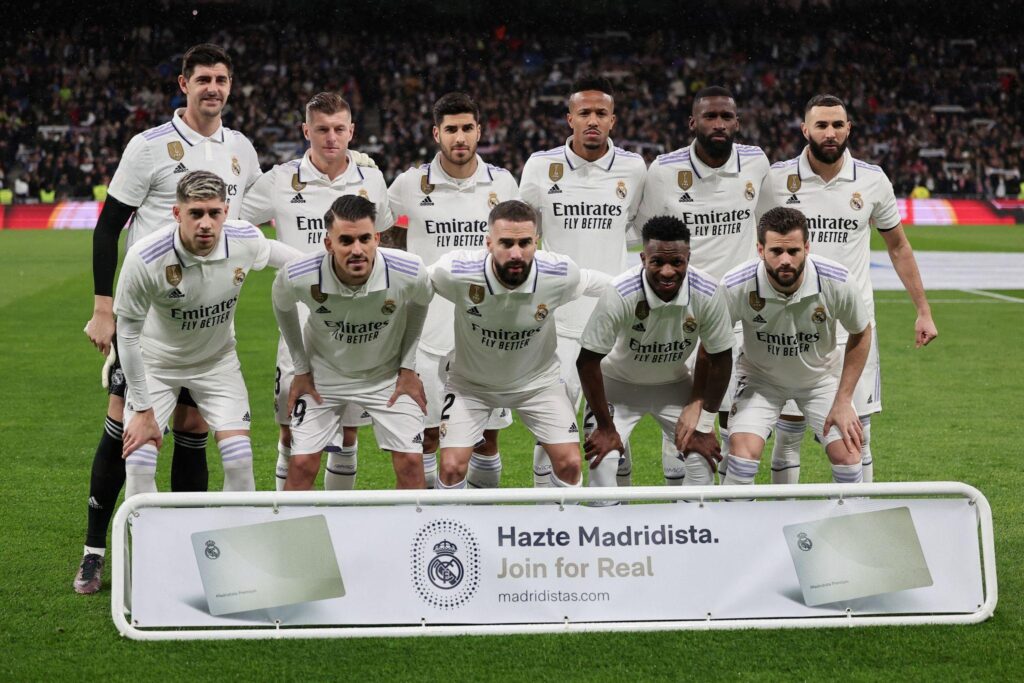
One of Real Madrid’s most recognizable partnerships is with Emirates.
The Emirates logo has appeared prominently on Real Madrid’s first-team shirt for many years.
This partnership is extremely valuable because the airline is able to associate itself with one of the world’s most recognizable sports brands.
Think about what happens during a Real Madrid match.
Millions of viewers see the players.
Millions see the shirts.
Millions see the Emirates logo.
That is essentially global advertising on a massive scale.
Adidas and Real Madrid
Another major partnership is with Adidas.
Adidas produces Real Madrid’s official playing kits and a huge range of merchandise.
This partnership goes beyond football shirts.
It includes:
- Training kits
- Lifestyle clothing
- Shoes
- Jackets
- Replica shirts
- Fan merchandise
Every time a supporter buys a Real Madrid Adidas shirt, there is commercial value for both the club and the manufacturer.
The relationship therefore creates a powerful commercial ecosystem.
HP and Real Madrid
Real Madrid also has a major partnership with HP.
HP became the first brand to feature on the club’s sleeve in its men’s and women’s football teams, adding another significant commercial asset to the famous Real Madrid shirt.
The partnership also extends beyond simple logo placement.
Modern sponsorship agreements increasingly involve:
- Digital campaigns
- Technology
- Content creation
- Fan engagement
- Women’s football
- Community programmes
This is how football sponsorship has evolved.
Sponsorship Is No Longer Just Putting a Logo on a Shirt
This is one of the biggest changes in modern football.
Years ago, sponsorship was relatively simple.
A company would pay a club.
The club would put the company’s logo on the shirt.
That was largely it.
Today, sponsorship can involve an entire commercial relationship.
A company might receive:
- Shirt exposure
- Social-media promotion
- Advertising rights
- Stadium branding
- Hospitality tickets
- Player appearances
- Exclusive content
- Digital campaigns
- Merchandise opportunities
- International marketing campaigns
This means a sponsorship deal can become a major business partnership.
Real Madrid’s Global Fanbase Is Its Biggest Asset
Real Madrid’s biggest commercial asset isn’t actually its stadium.
It isn’t its shirt.
It isn’t even its players.
It is the club’s global audience.
A company wants to reach people.
Real Madrid already has those people watching.
The club’s enormous social-media following means sponsors can reach fans even when there isn’t a match being played.
A single post featuring a Real Madrid player can potentially be viewed by millions of people.
That creates extraordinary advertising value.
The Santiago Bernabéu Makes Real Madrid Even More Valuable
Real Madrid’s stadium is another major component of its commercial strategy.
The renovated Santiago Bernabéu is designed to operate as much more than a traditional football stadium.


The modern stadium provides opportunities for:
- Hospitality
- VIP experiences
- Restaurants
- Events
- Concerts
- Stadium tours
- Corporate activities
- Retail
- Premium seating
This gives Real Madrid opportunities to generate revenue throughout the year.
The stadium itself therefore becomes a commercial platform.
The Bernabéu Is More Than a Football Stadium
Imagine a company wanting to host an event for hundreds or thousands of customers.
A modern stadium such as the Bernabéu can provide:
Venue
Entertainment
Brand exposure
Hospitality
Football association
That creates additional commercial value for Real Madrid.
The stadium can therefore continue generating money even when Real Madrid isn’t playing a league match.
Barcelona Is Real Madrid’s Biggest Rival Commercially
If Real Madrid is at the top, Barcelona is one of its strongest competitors.
Barcelona is one of the most recognizable football brands on Earth.
In the 2024/25 season, Barcelona generated approximately:
€975 million
in total revenue, placing it second behind Real Madrid in Deloitte’s global football revenue ranking. (deloitte.com)
Barcelona’s commercial strength comes from:
- Its global fanbase
- Lionel Messi’s enormous historical impact
- The club’s sporting history
- Sponsorships
- Merchandise
- Stadium opportunities
- International partnerships
The club’s commercial potential is enormous.
Manchester City Is Another Commercial Powerhouse
Manchester City has rapidly transformed itself into one of football’s biggest commercial brands.
The club generated approximately:
£694 million
in total revenue in 2024/25.
Of that:
£340.4 million
came from commercial activities. (mancity.com)
Manchester City’s commercial portfolio includes major partnerships with brands such as:
- Etihad Airways
- Puma
- OKX
- EA Sports
- Asahi
- Nexen Tire
The club’s dramatic growth on the pitch over the past decade has also helped transform its global commercial profile.
Bayern Munich Is Another Major Player
Bayern Munich is Germany’s biggest football club and one of Europe’s most powerful brands.
The club generated approximately:
€861 million
in revenue during 2024/25, according to Deloitte’s Football Money League.
That made Bayern the third-highest revenue-generating football club in the world during that season. (reuters.com)
Bayern’s commercial strength is particularly impressive because of its enormous domestic following and international reputation.
Manchester United Remains a Sponsorship Giant
Manchester United is another club that cannot be ignored when discussing football sponsorship.
Even though its recent sporting performances have not matched the club’s greatest periods, its commercial brand remains enormous.
Manchester United has historically attracted major partnerships because of:
- Its huge global fanbase
- Premier League exposure
- Historic success
- International recognition
- Massive social-media audience
- Commercial history
This demonstrates something important:
A club’s commercial value doesn’t disappear immediately when its sporting performance declines.
A club can have decades of accumulated brand value.
Why Winning Trophies Helps Sponsorship
Sporting success and commercial success are closely connected.
When a club wins:
🏆 League titles
🏆 Champions League trophies
🏆 Domestic cups
its visibility increases.
More people talk about the club.
More people watch its matches.
More people buy its merchandise.
More companies want to associate themselves with it.
This creates a cycle:
Success
⬇️
More attention
⬇️
More fans
⬇️
More commercial value
⬇️
More sponsorship opportunities
⬇️
More revenue
⬇️
More ability to invest in the team
And potentially:
More success.
But Sponsorship Isn’t Everything
A common mistake is to think that sponsorship is the only way football clubs make money.
It isn’t.
The biggest clubs have several revenue streams.
For example:
📺 Broadcasting
Money from television and streaming rights.
🤝 Sponsorship
Money from commercial partnerships.
🏟️ Matchday
Tickets and hospitality.
👕 Merchandise
Shirts and other products.
🏆 UEFA competitions
Champions League and Europa League revenue.
⚽ Player transfers
Money received from selling footballers.
📱 Digital
Online content and commercial activities.
The strongest clubs combine all of these.
Real Madrid’s Commercial Formula
Real Madrid’s strength comes from combining almost every major source of football revenue.
Think of the club as a giant commercial ecosystem.
Global fanbase
↓
Huge social-media reach
↓
Television exposure
↓
Major sponsors
↓
Merchandise sales
↓
Stadium revenue
↓
Champions League exposure
↓
More global attention
↓
More sponsorship opportunities
This is why Real Madrid continues to attract some of the world’s biggest companies.
Which Football Club Has the Most Sponsors?
There is no universally accepted answer based purely on the number of sponsors.
Clubs don’t all publish their sponsorship portfolios in exactly the same way, and many have regional partnerships that aren’t always publicly listed together.
However, if the question is:
“Which football club has the strongest overall sponsorship and commercial business?”
then Real Madrid is one of the clearest answers.
Its €594 million commercial revenue in 2024/25 demonstrates the enormous scale of its commercial operation. (realmadrid.com)
The World’s Biggest Football Sponsors
Football sponsorship isn’t dominated by one type of company.
Some of the biggest sponsors in football come from industries such as:
Airlines
Emirates, Etihad and Qatar Airways have all been heavily involved in football sponsorship.
Sportswear
Adidas, Nike and Puma compete for some of football’s biggest kit deals.
Technology
Technology companies increasingly partner with football clubs.
Financial services
Banks, payment companies and financial institutions have become major football sponsors.
Automotive
Car manufacturers have historically been heavily involved in football.
Gambling and betting
In markets where permitted, betting companies have also become significant football sponsors.
Why Companies Spend Millions on Football Sponsorship
Imagine a company wants to advertise to 100 million people.
It could buy thousands of traditional advertisements.
Or it could partner with a globally recognized football club.
Every time millions of people watch the team, the company’s brand can appear.
But there is something even more powerful:
Emotion.
Football supporters are emotionally connected to their clubs.
When a fan sees the club’s shirt, stadium or players, they don’t simply see an advertisement.
They see something they love.
Companies want to associate themselves with that emotional connection.
The Future of Football Sponsorship
Football sponsorship is likely to become even more sophisticated.
Future partnerships will increasingly involve:
- Artificial intelligence
- Digital content
- Social media
- Streaming
- Virtual experiences
- Data analytics
- E-commerce
- International fan communities
- Women’s football
- Esports
- Technology
Instead of simply putting a logo on a shirt, companies will increasingly want to become part of a club’s entire digital ecosystem.
The world’s biggest clubs are perfectly positioned to take advantage of this.
Real Madrid’s Position at the Top
Real Madrid’s ability to generate more than half a billion euros in commercial revenue demonstrates why the club is such an attractive partner for global companies.
The club combines:
Sporting success
Global popularity
Historic prestige
Superstar players
A world-famous stadium
Massive digital reach
Champions League exposure
Major commercial partnerships
That combination is incredibly difficult for another club to replicate.
Final Verdict: Who Is the Most Sponsored Football Club in the World?
If we are measuring the overall commercial power and sponsorship strength of football clubs, Real Madrid currently has the strongest claim to the title of:
🏆 THE WORLD’S MOST COMMERCIALLY POWERFUL FOOTBALL CLUB
In the 2024/25 season, the club generated approximately:
€1.161 billion in total revenue
and:
€594 million in commercial revenue. (realmadrid.com)
Its commercial strength comes from a combination of global sponsorships, merchandise, licensing, partnerships and other commercial activities.
Barcelona remains one of its biggest competitors, while Manchester City, Bayern Munich and Manchester United also possess enormous commercial power.
But Real Madrid has something particularly difficult to reproduce:
A century of history combined with modern global marketing.
The club has turned its sporting success into a worldwide commercial empire.
And as football becomes increasingly global, the clubs with the biggest audiences will continue to attract the biggest companies.
That is why modern football isn’t simply about who scores the most goals.
It is also about:
Who attracts the biggest audience?
Who has the strongest brand?
Who can reach the most consumers?
And who can convince the world’s biggest companies to pay millions to be associated with them?
At the moment, Real Madrid sits at the top of that commercial mountain.